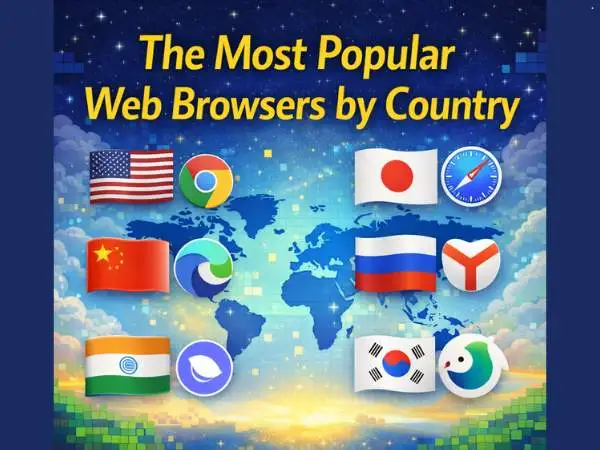
The browser wars have been raging since the early days of the internet. From the rise and fall of Netscape and Internet Explorer to the modern dominance of a few key players, how we access the web is constantly shifting. But if you look at the globe today, the digital map is overwhelmingly painted in a few distinct colors.
Whether you are surfing the web from a cafe in Paris, a train in Tokyo, or your couch in New York, the tools you use are likely dictated by a mix of regional preferences, mobile dominance, and ecosystem lock-ins.
Here is a full breakdown of the most popular web browsers by country and region based on the latest global market share data.
The Global King: Google Chrome

Before diving into specific borders, we have to talk about the undisputed global champion: Google Chrome.
Accounting for roughly 66% of the global browser market, Chrome’s massive lead has been virtually untouchable since it dethroned Internet Explorer back in 2012. Its dominance is fueled by its speed, its vast library of extensions, and its deep integration with the Android operating system, which holds the lion’s share of the global smartphone market.
Following far behind Chrome is Apple’s Safari (holding around 17-18% globally), followed by Microsoft Edge (~5%), Firefox (~3%), and regional players like Samsung Internet and Opera (each hovering around 2%).
However, when you break the data down by country, region, and device, the story gets a lot more interesting.
also read : – VidMate The best application for Windows and Mac Computers
North America: The Apple Ecosystem Effect

In North America, the battle is much tighter than the global average, largely due to the massive popularity of the iPhone.
- United States & Canada: While Chrome still holds the #1 spot across all devices combined (around 52-61%), Safari puts up a massive fight. In fact, when looking strictly at mobile and tablet usage in the US and Canada, Safari frequently flips the script and takes the #1 spot, hovering around 50% mobile market share.
- The Takeaway: If you are on a desktop in North America, you are likely using Chrome or Edge. If you are on a phone or tablet, there is a very high chance you are swiping through Safari.
Europe: A Diverse Mix with a Soft Spot for Underdogs
Europe generally mirrors the global trend, but it boasts a slightly more diverse browser landscape, often driven by data privacy laws and tech-savvy user bases.
- Western & Northern Europe (UK, Germany, France): Chrome remains the dominant force (around 60%), with Safari taking its standard second place.
- The Firefox Strongholds: While Firefox’s global share has dipped, it still holds a deeply loyal user base in countries like Germany and parts of Eastern Europe (like Armenia). European users tend to favor Mozilla’s open-source browser for its strict tracking protection and non-profit backing.
- Opera’s Scandinavian Roots: Opera, originally developed in Norway, still maintains a noticeable, dedicated footprint across Northern Europe.
Asia: The Rise of Local Browsers
Asia has the largest internet user base in the world, and Chrome dominates here with over 70% of the market. However, local tech ecosystems create unique anomalies.
- China: While Chrome is technically widely used, the Chinese market is heavily fragmented by homegrown browsers tailored to local internet restrictions and services. UC Browser (owned by Alibaba), QQ Browser (owned by Tencent), and 360 Safe Browser command significant chunks of the market.
- South Korea: Thanks to the dominance of the Samsung brand, Samsung Internet sees some of its highest usage rates in the world here, frequently pushing past Edge and Firefox as the default choice on millions of Galaxy devices.
South America & Africa: Android’s Undisputed Territory
In regions where mobile internet heavily outpaces desktop usage, and where Android devices are far more affordable than Apple products, Chrome’s market share hits its absolute peak.
- South America (Brazil, Argentina, Colombia): Chrome commands a staggering 78%+ of the market. Safari usage drops into the single digits (around 7%) simply because iPhones hold a much smaller market share in the region compared to Androids.
- Africa: Similar to South America, Chrome is king at over 75%. However, Opera is incredibly popular across the African continent (approaching 8% market share). Why? Opera offers highly efficient data-compression tools (like Opera Mini), which is a massive selling point in countries where mobile data can be expensive or internet connections are slower.+1
Oceania: The Closest Two-Horse Race
Oceania (primarily Australia and New Zealand) mirrors the North American market but with an even stronger showing for Apple.
- Australia: Chrome holds roughly 55% of the market, while Safari captures a massive 28% to 30%. Because Australians are heavy adopters of Apple products (MacBooks, iPhones, and iPads), Safari sees some of its highest regional usage rates in the world here.
also read : – How Technology Is Helping Pilots And Air Traffic Controllers Communicate Better
The Verdict: Why Do We Choose the Browsers We Do?
Looking at the map, it becomes clear that “browser preference” is rarely about the browser itself anymore; it is about the default hardware ecosystem.
- You buy an Android or a Chromebook? You use Chrome.
- You buy an iPhone or a Mac? You use Safari.
- You buy a Windows PC? You are likely using Edge (at least to download Chrome!).
While niche browsers like Brave, Vivaldi, and DuckDuckGo are slowly growing among privacy-conscious users, the global map for 2026 remains a testament to the power of the default setting. Until a massive shift in mobile hardware occurs, Google Chrome will comfortably maintain its crown as the king of the world wide web.